
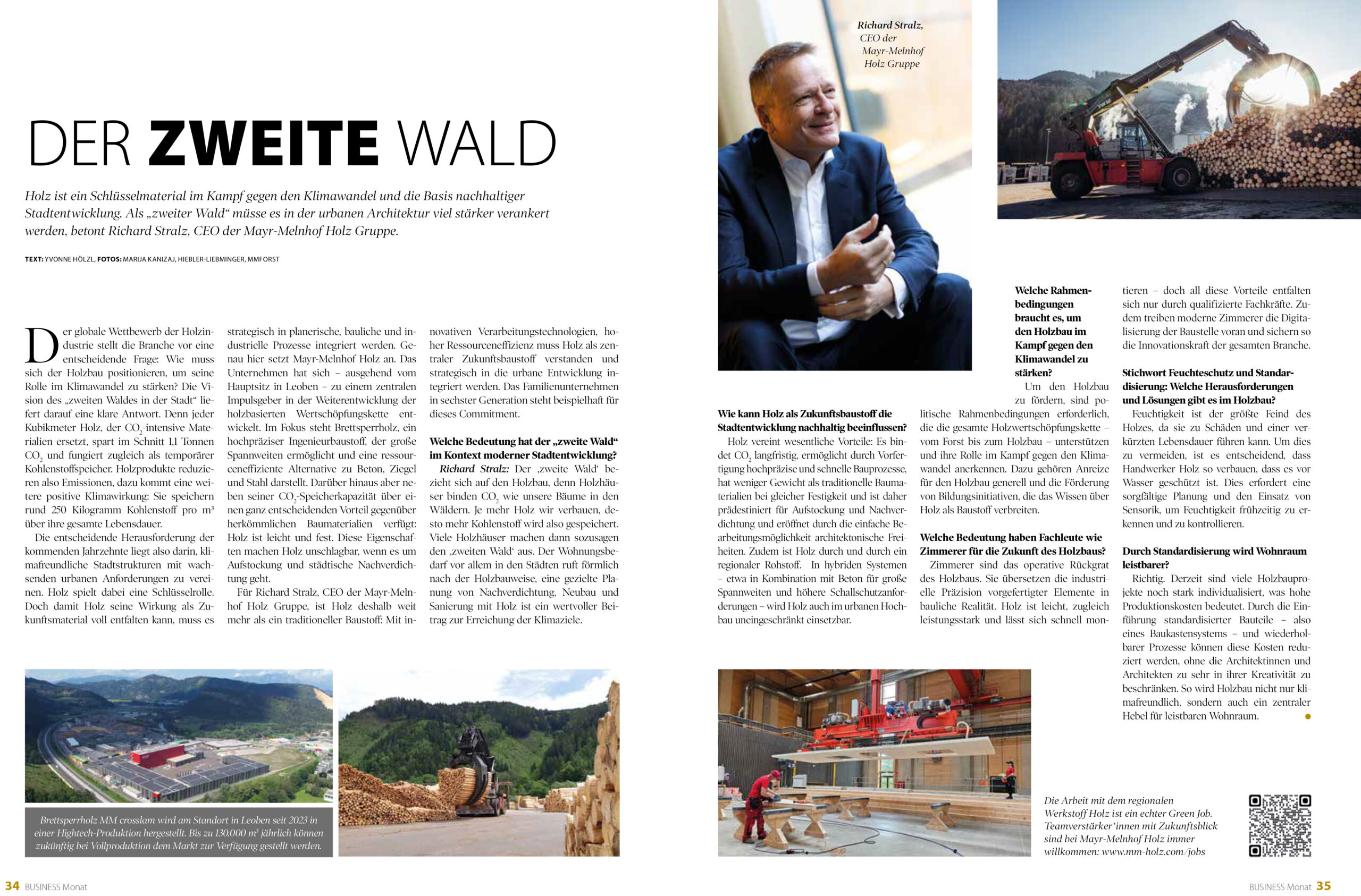
Fact is: Every cubic meter of wood that replaces CO₂-intensive materials saves an average of 1.1 tons of CO₂ and stores carbon for decades. This makes timber construction the decisive lever for climate-friendly building. CEO Richard Stralz on the “second forest” and the future building material cross-laminated timber (CLT), which must urgently be strategically integrated into urban development.
What significance does the “second forest” have in the context of modern urban development?
The “second forest” refers to timber construction, as wooden buildings bind CO₂ just like the trees in our forests. Therefore, the more wood we use in construction, the more carbon is stored. A large number of wooden houses then effectively form this “second forest.” The demand for housing, especially in cities, practically cries out for timber construction. Targeted planning of urban densification, new construction, and renovations using wood makes a valuable contribution to achieving climate targets.
How can wood, as a building material of the future, sustainably influence urban development?
Wood combines essential advantages: it binds CO₂ over the long term, enables highly precise and rapid construction processes through prefabrication, weighs less than traditional building materials while offering the same strength—making it predestined for building extensions (adding floors) and urban densification—and opens up architectural freedom due to its ease of processing. Furthermore, wood is a thoroughly regional raw material. In hybrid systems—for example, in combination with concrete for large spans and higher sound insulation requirements—wood can also be used without restriction in urban high-rise construction.
What framework conditions are needed to strengthen timber construction in the fight against climate change?
To promote timber construction, political framework conditions are required that support the entire timber value chain—from forestry to timber construction—and recognize its role in the fight against climate change. This includes incentives for timber construction in general and the support of educational initiatives that spread knowledge about wood as a building material.
What is the significance of professionals like carpenters for the future of timber construction?
Carpenters are the operational backbone of timber construction. They translate the industrial precision of prefabricated elements into physical reality. Wood is lightweight yet highly performant and quick to assemble—but all these advantages can only unfold through qualified professionals. In addition, modern carpenters are driving the digitalization of the construction site, thereby securing the innovative power of the entire industry.
Keyword moisture protection and standardization: What are the challenges and solutions in timber construction?
Moisture is the greatest enemy of wood, as it can lead to damage and a shortened lifespan. To prevent this, it is crucial that craftsmen install wood in a way that protects it from water. This requires careful planning and the use of sensor technology to detect and monitor moisture at an early stage.
Does standardization make living space more affordable?
Correct. Currently, many timber construction projects are still highly customized, which leads to high production costs. By introducing standardized components—essentially a modular system—and repeatable processes, these costs can be reduced without overly restricting the creativity of architects. In this way, timber construction becomes not only climate-friendly but also a central lever for affordable housing.
Article published in: https://www.businessmonat.at/jaenner-2026